
For Bible Translation Publishers
How Rebuilding Faith protects, attributes, and honors the Bible translations entrusted to us.
Rebuilding Faith is a free Bible study and journaling application supported by donations. This page summarizes the commitments and controls we put in place when a publisher licenses a translation to us — covering content protection, attribution, AI usage, reporting, and the ongoing partnership. We are happy to tailor any of these to a specific translation’s requirements.
Last updated: June 5, 2026
License Scope & Ownership
License Scope & Permitted Use
Rebuilding Faith will use the licensed translation only within the Rebuilding Faith application and related services. The translation will not be sold, sublicensed, distributed as a standalone file, or made available for bulk download.
User License Agreement & Acceptance
Where a publisher requires it, Rebuilding Faith can present the translation’s license agreement and require each user to review and accept it before the translation can be read. Until the agreement is accepted, the translation’s text is not displayed.
If the license agreement is later updated, users are prompted to review and re-accept the new terms before continuing to read.
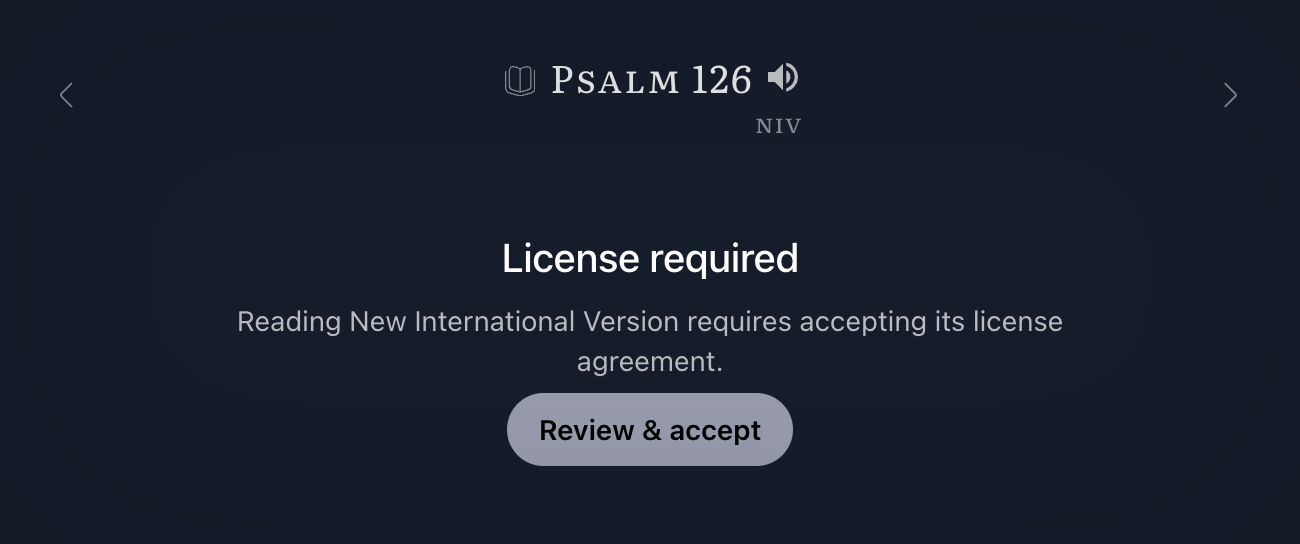
Before a licensed translation can be read, the user is shown a “License required” notice with a clear call to review and accept the agreement.
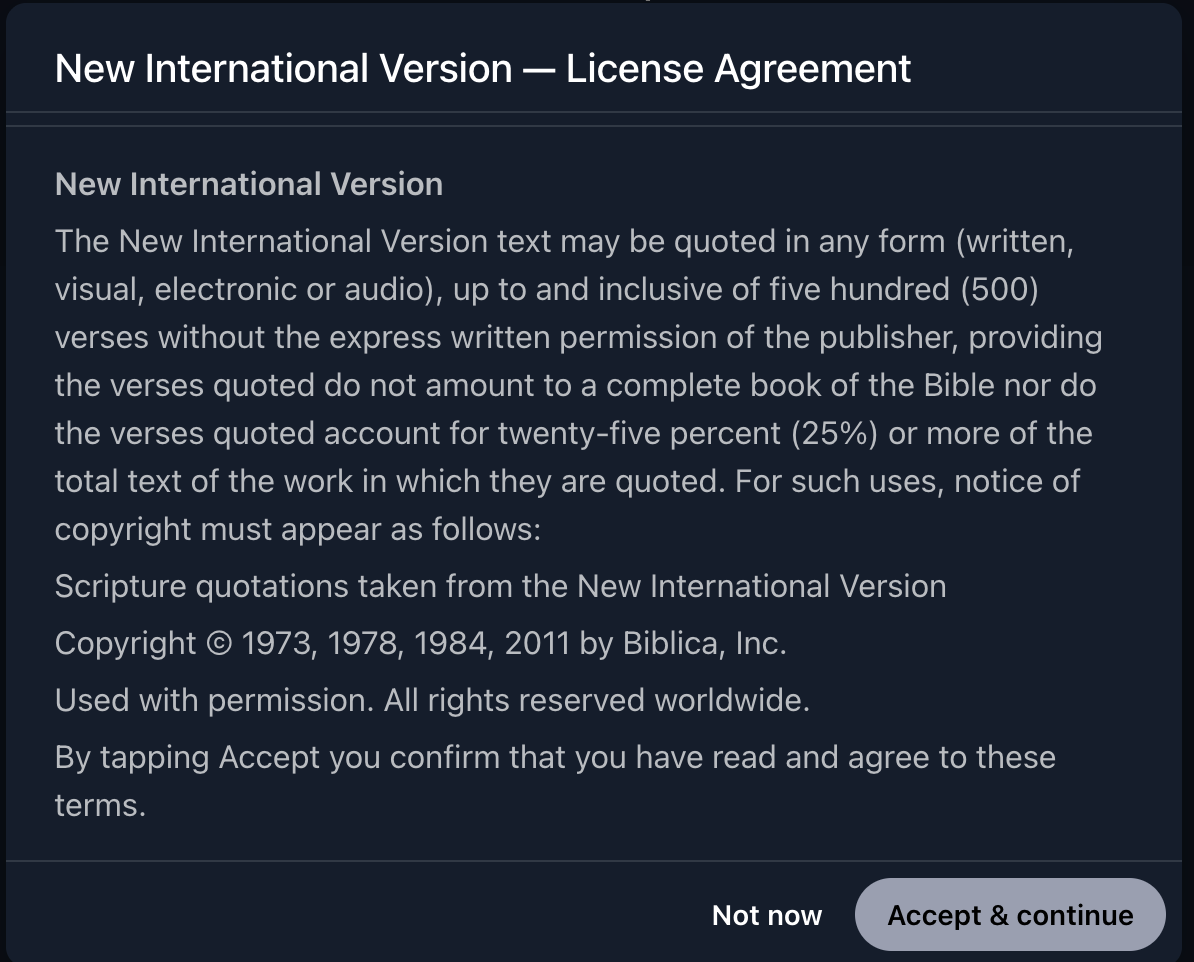
The publisher’s license agreement is shown in full. The translation stays locked until the user taps Accept & continue.
Data Ownership & User Content
User-created notes remain user content. Any scripture text included in a note remains subject to the applicable translation license and related usage limits.
Protecting Translation Content
We treat licensed scripture as protected content at every layer — in transit, at rest, on device, and in the features built on top of it.
API Access & Text Transmission
Rebuilding Faith provides a web application, native iOS apps for Mac, iPad, and iPhone, and native Android apps for phones and tablets. Each of these requests Bible chapters from the Rebuilding Faith API, and we protect that content along the way:
- The API requires authentication, so every request for Bible text is tied to an identified user.
- Bible text requests are throttled on a per-user basis.
- Bible text is transmitted securely over standard HTTPS.
- Bible text is stored encrypted at rest in Rebuilding Faith's internal database.
Offline Access & Local Copies
The app lets users download translations for offline reading. To protect that local copy:
- Where a publisher requires it, offline copies of the translation are encrypted on the device using AES-256-GCM — a 256-bit, industry-standard authenticated-encryption cipher.
- The encryption key is generated on the device and held in the operating system’s secure storage — the iOS Keychain or Android Keystore — separate from the translation data it protects.
- On the native iOS and Android apps, a protected translation is only ever stored in this encrypted form. In the web app, offline download of a protected translation is disabled entirely, so no unencrypted local copy is created.
- Offline translation files may be updated or removed when the application syncs — including when a translation is corrected, updated, or no longer licensed.
Journaling & Notes
Users can add verses to their notes, and notes can be printed or shared. Notes also function as cross-references and topical indexes, which are core features of the application. To balance these uses with content protection:
- The app can limit the number of verses and/or chapters displayed at one time. Users can still scroll the full note, but cannot copy, export, share, or print beyond the applicable limit.
- Separate limits can be applied to copy, export, share, and print actions.
- Copy, export, share, and print limits can be configured per translation according to publisher requirements.
- A user agreement can limit how printed or exported material may be used.
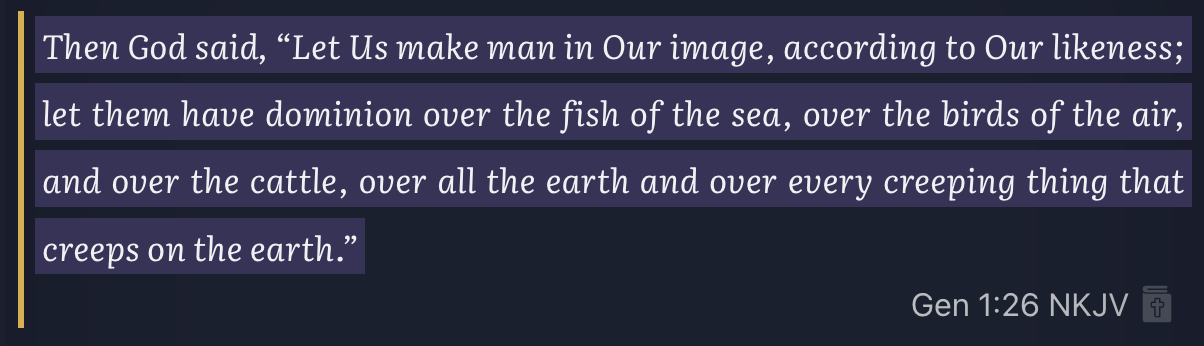
Inside a user’s note, every quoted verse keeps its reference and translation abbreviation — here “Gen 1:26 NKJV”.
Breach & Abuse Response
Rebuilding Faith can investigate abnormal usage patterns and may restrict, throttle, or disable access for users who appear to be attempting unauthorized extraction or misuse of translation content.
Attribution & Copyright
Copyright Notice
Rebuilding Faith displays the publisher’s copyright and attribution with the translation:
- The full copyright notice is provided when the translation is displayed.
- A short copyright notice appears at the bottom of each chapter.
- Scripture references include the translation abbreviation.
- We can provide a hyperlink to the publisher’s website.
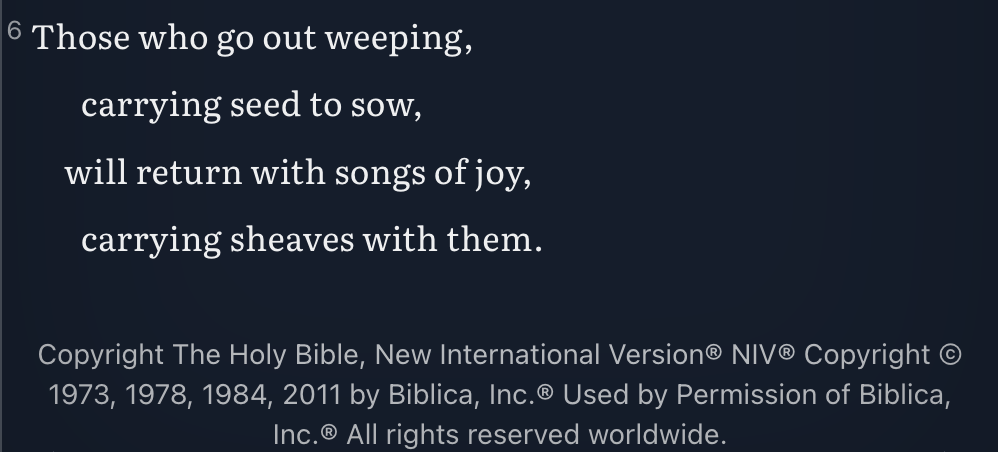
The short copyright notice appears at the bottom of each chapter, beneath the scripture text.
Where Attribution Appears
Copyright and attribution details are included throughout the experience:
- On the attributions page
- On the translation information screen
- On the chapter view (shortened copyright notice)
- On scripture references (translation abbreviation alongside the quote)
- In printed content (translation abbreviation alongside the quote)
- In exported notes (translation abbreviation alongside the quote)
Inside a user’s note, every quoted verse keeps its reference and translation abbreviation — here “Gen 1:26 NKJV”.
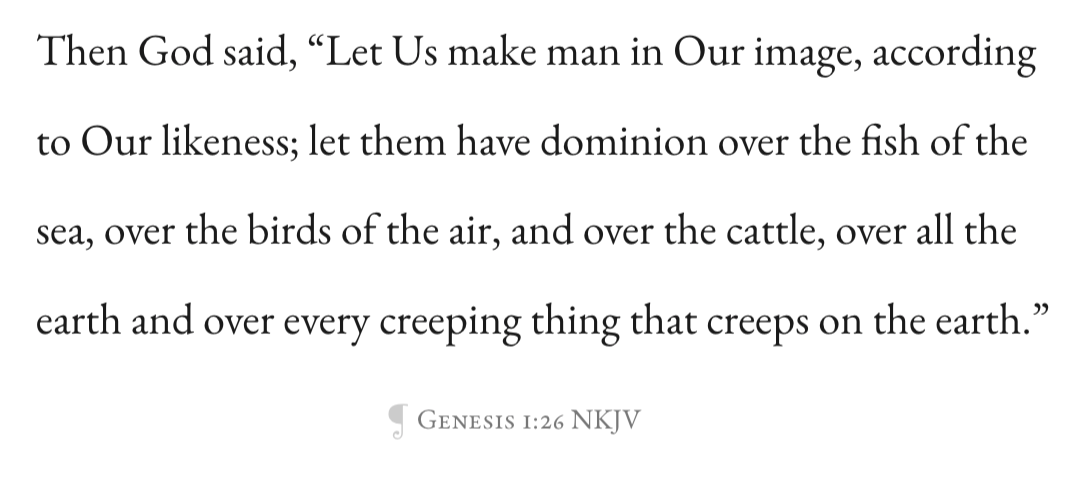
The same reference and abbreviation carry through to printed and exported notes.
Footnotes
Rebuilding Faith displays publisher-provided footnotes alongside the corresponding Bible translation text.
AI Usage Restrictions & Controls
Rebuilding Faith treats the use of AI in connection with licensed Bible translation content as a restricted capability.
Restrictions on AI & Scripture
Rebuilding Faith does not use AI to generate, rewrite, interpret, summarize, paraphrase, or otherwise render Bible translation text for display to users. Any scripture text shown to users is displayed directly from the licensed source text and is never generated or modified by AI.
AI-enabled features are made available only where they are explicitly initiated by the user and where such use is permitted for the applicable translation. AI features are never applied automatically to licensed scripture content without user action and appropriate authorization.
Current AI Usage
Today, Rebuilding Faith uses AI only for user-directed transcription — converting user-provided media into text:
- Transcribing text from images the user provides.
- Transcribing audio recordings the user provides.
These features convert user-provided media into text. They are not used to interpret, modify, summarize, or generate licensed scripture content.
Potential Future AI Features
Any additional AI features will be user-directed and subject to the applicable permissions and restrictions for the relevant translation. Potential future features may include:
- Smart organization or grouping of verses and text within a user’s note.
- Reading or processing of a user’s notes, which may include scripture references or quoted scripture.
- Semantic search of a user’s own notes — searching by meaning rather than only by exact keyword.
Semantic search may involve AI-assisted interpretation of the meaning of a user’s query and/or notes, for the limited purpose of identifying relevant results. Results consist only of the user’s own notes and any scripture text included in those notes or displayed directly from the authorized source text. Scripture text returned in search results is never rewritten, paraphrased, summarized, interpreted, or generated by AI.
Cost & User Access
Free to Users, Funded by Donations
Rebuilding Faith makes Bible translations available to users free of charge. The application is offered at no cost and relies on voluntary donations rather than subscription fees, paywalls, or per-translation charges.
Where appropriate and permitted by the publisher, Rebuilding Faith may include a request or link encouraging users to donate directly to the publisher or translation organization, supporting the ongoing work of producing, maintaining, and distributing the translation.
Updates & Synchronization
Keeping the Translation Current
Rebuilding Faith can automatically update Bible text, footnotes, and related translation content within 7 days of receiving updated source files.
Users who are offline may receive updates later, once their device reconnects and syncs with the application.
Reporting
Usage Reporting
Rebuilding Faith can provide usage reporting related to the translation, including FUMS-style reporting where required by the publisher.
- Reports can include metrics such as translation access, chapter views, and active users, subject to the reporting requirements agreed with the publisher.
- Usage reporting can be provided in aggregate form.
- Reporting is based on application usage data and never includes user notes, journal content, or other private user-generated content.
Partnership & Governance
Publisher Review & Approval
Rebuilding Faith can provide screenshots or access for publisher review of translation display, copyright notices, footnotes, and related attribution. We are glad to provide access to our beta environment for review.
Termination & Removal
If the license is terminated or expires, Rebuilding Faith can remove the translation from the application and prevent future access, subject to any agreed transition period.
Support & Contact
Rebuilding Faith will provide a designated contact for publisher questions, correction requests, reporting issues, and license-related concerns.
Let’s Talk
We would welcome the opportunity to walk you through how your translation would be displayed, attributed, and protected — and to give you access to our beta environment to review it firsthand.
Book a Call →